 |  |  |  |  |  |  |  |  |  |  |  |

| The New York Optimist |

WINTER HAIKU
December 10, 2009 – January 30, 2010
Jenkins Johnson Gallery
San Francisco, CA
464 Sutter Street, San Francisco , CA 94108
T: 415.677.0770; F: 415.677.0780
sf@jenkinsjohnsongallery.com
Hours: Tues. – Fri. 10 am – 6 pm; Sat. 10 am – 5 pm
Jenkins Johnson Gallery
New York, NY
521 W. 26th St. , 5th Floor, New York , NY 10001
T: 212.629.0707; F: 212.629.4255
ny@jenkinsjohnsongallery.com
Hours: Tuesday - Saturday 10 am – 6 pm
Both galleries will be closed December 24, 2009 through
January 4, 2010 for the winter break.
December 10, 2009 – January 30, 2010
Jenkins Johnson Gallery
San Francisco, CA
464 Sutter Street, San Francisco , CA 94108
T: 415.677.0770; F: 415.677.0780
sf@jenkinsjohnsongallery.com
Hours: Tues. – Fri. 10 am – 6 pm; Sat. 10 am – 5 pm
Jenkins Johnson Gallery
New York, NY
521 W. 26th St. , 5th Floor, New York , NY 10001
T: 212.629.0707; F: 212.629.4255
ny@jenkinsjohnsongallery.com
Hours: Tuesday - Saturday 10 am – 6 pm
Both galleries will be closed December 24, 2009 through
January 4, 2010 for the winter break.

| Scott Fraser, Striped Butterfly, 2009 oil on copper, 6 x 6 inches Clothes make the insect / Can't help but notice these broad / bands of black and green - Bronwyn Fraser |

| Julia Fullerton-Batten, Library, 2007, c-type print, 40 x 54 inches edition of 7 and 31 x 25 inches, edition of 15 I read / she reads / winter evening - Lee Gurga |
Jenkins Johnson Gallery is pleased to announce a group exhibition of Winter Haiku in both San Francisco and New York . Participating artists include: Ben
Aronson, Katherine Chang Liu, Gerald Förster, Scott Fraser, Julia Fullerton Batten, Lynn Goldsmith, Wes Hempel , Etsuko Ichikawa, Courtney Johnson,
Rene Lynch, Scott Prior, Kay Ruane, Sonya Sklaroff, Skip Steinworth, Francesca Sundsten, Janice Urnstein Weissman, Hiroshi Watanabe, Jason
Wheatley, ZZ Wei, Don Williams, Michael Workman, Sherrie Wolf, JeongMee Yoon and others. Not all artists will be exhibited at both locations.
Aronson, Katherine Chang Liu, Gerald Förster, Scott Fraser, Julia Fullerton Batten, Lynn Goldsmith, Wes Hempel , Etsuko Ichikawa, Courtney Johnson,
Rene Lynch, Scott Prior, Kay Ruane, Sonya Sklaroff, Skip Steinworth, Francesca Sundsten, Janice Urnstein Weissman, Hiroshi Watanabe, Jason
Wheatley, ZZ Wei, Don Williams, Michael Workman, Sherrie Wolf, JeongMee Yoon and others. Not all artists will be exhibited at both locations.
Winter Haiku mixes small to medium size paintings, photographs, glass sculpture and works on paper and compliments each unique piece with a haiku -- the form of
Japanese poetry consisting of three metrical phrases in 5, 7, and 5 syllables. All the artists showcased in the exhibition comment and observe on life and the world
around us in thoughtful, unique, and colorful ways. Their innovative techniques and new ideas challenge the way we think and understand art.
Some highlights of the exhibition include artists Scott Fraser, Julia Fullerton-Batten, Courtney Johnson, and Etsuko Ichikawa. Scott Fraser’s whimsical
miniatures are simple, charming and delectable. His seasoned realistic style combined with his application of a striking, vivid, contrasting palette reveal hyper-realistic
depictions of a glamorous butterfly, a delicate line of shells, and even a lovely sea urchin. The haiku pairings, written by members of his family, attach a sentimental
association to each painted object, true to Fraser's style. Investigating the psyche of the teenage girl, Julia Fullerton-Batten presents evocative imagery that tunnels
back to memories of youthful, emotional experiences. Girls gathered in a stately, old-world, cherry-wood library, all dressed in uniform to look identical, well-
behaved, and studious, but underlying feelings of growing pains, self-investigation and awkwardness can be seen in their uncomfortable stances and expressions.
Balancing the tight realism and photographic works in this exhibition are the abstract hand blown glass sphere sculptures by emerging artist Courtney Johnson that
glimmer with faint silver images that emerge from the surface. The spheres represent memory capsules with images of people and buildings that evoke a precious
nostalgia. Similar to Johnson, Etsuko Ichikawa’s technique is wonderfully innovative and unique, and yet the result is subtle, simple and sensual. Her ethereal glass
pyrographs are created by drawing with molten glass. Ichikawa melts the glass on the tip of a stick and traces it over the paper forming organic, fluid lines. Her
process is as rhythmical and fascinating as the product itself. The written word element to these works has been letter pressed by the artist onto the works
themselves, creatively interlacing the written word and the artwork.
Symbolism, gestured mark-making, color interaction, subject, light and shadow all define what a painting, drawing or photograph intends to convey. Similarly in
poetry such as haiku, the placement of each word, the aural effects of the words in line, and fragmented sentences or short phrases depict a narrative, a person, a
place or, perhaps, a feeling. Elements of the story are left untold and the viewer or reader is left to decipher what the artist has presented with his or her own
interpretation, applied knowledge and personal experience. It's such that the essence of a painting lies beneath the surface and the essence of a haiku can be
interpreted between the lines. Winter Haiku parallels these two creative expressions, as this connection has been made many times throughout history, and allows the
words and artwork to interact with and define one another.
Japanese poetry consisting of three metrical phrases in 5, 7, and 5 syllables. All the artists showcased in the exhibition comment and observe on life and the world
around us in thoughtful, unique, and colorful ways. Their innovative techniques and new ideas challenge the way we think and understand art.
Some highlights of the exhibition include artists Scott Fraser, Julia Fullerton-Batten, Courtney Johnson, and Etsuko Ichikawa. Scott Fraser’s whimsical
miniatures are simple, charming and delectable. His seasoned realistic style combined with his application of a striking, vivid, contrasting palette reveal hyper-realistic
depictions of a glamorous butterfly, a delicate line of shells, and even a lovely sea urchin. The haiku pairings, written by members of his family, attach a sentimental
association to each painted object, true to Fraser's style. Investigating the psyche of the teenage girl, Julia Fullerton-Batten presents evocative imagery that tunnels
back to memories of youthful, emotional experiences. Girls gathered in a stately, old-world, cherry-wood library, all dressed in uniform to look identical, well-
behaved, and studious, but underlying feelings of growing pains, self-investigation and awkwardness can be seen in their uncomfortable stances and expressions.
Balancing the tight realism and photographic works in this exhibition are the abstract hand blown glass sphere sculptures by emerging artist Courtney Johnson that
glimmer with faint silver images that emerge from the surface. The spheres represent memory capsules with images of people and buildings that evoke a precious
nostalgia. Similar to Johnson, Etsuko Ichikawa’s technique is wonderfully innovative and unique, and yet the result is subtle, simple and sensual. Her ethereal glass
pyrographs are created by drawing with molten glass. Ichikawa melts the glass on the tip of a stick and traces it over the paper forming organic, fluid lines. Her
process is as rhythmical and fascinating as the product itself. The written word element to these works has been letter pressed by the artist onto the works
themselves, creatively interlacing the written word and the artwork.
Symbolism, gestured mark-making, color interaction, subject, light and shadow all define what a painting, drawing or photograph intends to convey. Similarly in
poetry such as haiku, the placement of each word, the aural effects of the words in line, and fragmented sentences or short phrases depict a narrative, a person, a
place or, perhaps, a feeling. Elements of the story are left untold and the viewer or reader is left to decipher what the artist has presented with his or her own
interpretation, applied knowledge and personal experience. It's such that the essence of a painting lies beneath the surface and the essence of a haiku can be
interpreted between the lines. Winter Haiku parallels these two creative expressions, as this connection has been made many times throughout history, and allows the
words and artwork to interact with and define one another.

| Etsuko Ichikawa, Turezuregusa1377 (essay 110), 2007, glass pyrograph and letterpress on paper, 11 x 7.5 inches |

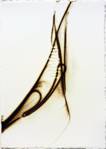

| Etsuko Ichikawa, Turezuregusa1467 (essay 155), 2007, glass pyrograph and letterpress on paper, 11 x 7 inches |
| Etsuko Ichikawa, Turezuregusa1527 (essay 229), 2007, glass pyrograph and letterpress on paper, 11 x 7 inches |
| Etsuko Ichikawa, Turezuregusa1607 (essay 155), 2007, glass pyrograph and letterpress on paper, 11 x 7 inches |

