| The New York Optimist |
 |  |  |  |  |  |  |  |  |  |  |  |


SHARE

May 6th and May 7th, 2009 UES and Chelsea Gallery Art Stampede
by
Stephan Fowlkes
Well, what a fun week for art viewing! We started Wednesday on the Upper East Side gallery crawl with nine
receptions, and let me tell you, what a world apart from Chelsea (for the most part). “Still Lifes of the Seventeenth
through Nineteenth Centuries” at Lawrence Steigrad Fine Arts (23 E. 69th Street), Giovanni Battista Piranesi’s
etchings from the eighteenth century at David Tunic, Inc. (19 E. 66th Street), “Master drawings and Paintings” at
Didier Aaron, Inc. (32 E. 67th Street), “Still Life” at Dickinson ( 19 E. 66th Street)including Henri Laurens, Picasso,
Juan Gris, among others--these were just a few shows indicative of the diversity presented way up there, but a
couple of the highlights were “Lyonel Fenninger at the Bauhaus” at Moeller, New York (36 E. 64th Street), and
“Alice Neel: Nudes of the 1930s” at Zwirner & Wirth (32 E. 69th Street).
Moeller presents a stunning selection of Feninger’s woodcuts, mostly on yellow Kozo paper, with imagery ranging
from pretty direct landscapes, city and nautical scenes to pure, geometric abstractions. But it was the Neel portraits
that really got me...the deep psychological qualities she so clearly draws out of her subjects and creates in their
settings presents the viewer with highly charged images, almost disturbing. There is a sense of Munch’s tortured
figures in these paintings, yet with a far greater sense of intimacy: Neel paints as much their emotional states as she
does their physical appearance. This show is a good preview of her concurrent show at David Zwirner opening May
14th in Chelsea. But possibly the best part of seeing this show on Wednesday was the way in which it prepped me
for Chantal Joffe’s large-scale portraits at Cheim & Read on Thursday.
(Back to Chelsea)
With over 25 openings on Thursday, Chelsea was hopping! From MFA Thesis exhibits to the Big Names, we had it
all this week: something for everyone and all tastes. Plus the weather agreed with us, making it an all-around
wonderful night of culture, conversation and entertainment.
Walking into Cheim & Read, we were immediately confronted by larger-than-life portraits--some up to ten feet tall,
by young British artist Chantal Joffe. This is her first show with the gallery, and what a debut! Having just been
treated to Neel’s portraits the night before, these were a perfect pairing. Joffe’s press release even mentions Neel,
but the work is in no way derivative; it is a continuation, a departure from where Neel left off, saturated in
contemporary commentary. The subjects of Joffe’s paintings are models, behind the scenes, photographed by the
artist at Paris fashion week, in a far more vulnerable state than we commonly see on the runway. The simple
directness of the paintings is remarkable in the manner which it elicits and emphasizes their gaze, their expressions,
occasional insecurity. These works come across as in-your-face, without being aggressive or confrontational; some
of this comes from the sheer scale, but there’s more: the simplicity of the backgrounds ranging from
monochromatic voids to simple settings emphasizes the figures, making them pop out at you, dominate you, even in
their seemingly fragile states. Painting isn’t dead, and portraiture certainly isn’t dead, and Chantal Joffe’s show of
paintings all from 2008-09 is a clear case-in-point. When Neel’s other show opens in Chelsea on the 14th, these two
shows will be a perfect pairing!
Chantal Joffe at Cheim & Read
547 W. 25th Street
May 7-June 20, 2009
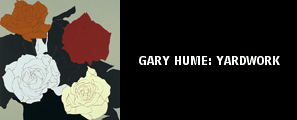
Another of those young British artists currently on view is Gary Hume at Matthew Marks Gallery. In his
signature style of high gloss enamel paintings, these thirteen new paintings present a departure from prior veins of his
work. Unlike the hospital doors of previous series, referencing the entering and departure of life (not to mention a
critical commentary of the state of the health system in the UK), Hume’s new door paintings are of those on his barn
in upstate New York. Less complex and political in nature, these new door paintings hail a certain minimalist
sensibility, compounded with formal concerns leading to an elegant, reductive, spare quality I find very appealing.
Other subject-matter includes birds and flower from first-hand observation of his surroundings in Accord, NY.
Previously, his subject-matter was culled from the media and appropriated from second-hand sources, so this is an
interesting departure. However, the technique and process remains largely the same: working with mostly high-
gloss enamel, he creates large monochromatic forms loosely depicting his subject-matter, hard-edged to the point of
a physical ridge separating the forms in his works. Clean, intense and precise, these works offer an elegant
juxtaposition with Joffe’s more painterly style.
Gary Hume: Yardwork
Matthew Marks Gallery
522 W. 22nd Street
May 7-June 27, 2009
But possibly the most exciting show of the evening for me was the collection of eclectic, colorful, whimsical
assemblages by Jessica Stockholder at Mitchell-Innes & Nash. Where Rauschenberg left off with his combines,
Stockholder has successfully picked up the torch and run with it. Like Rauschenberg, Stockholder successfully
bridges the gap between sculpture and painting, blurring the lines of definition (think Rauschenberg’s Combines).
But beyond historical reference, and possibly more importantly, is the clear impact her oeuvre has had on the
subsequent generations since. Her additive, collage-oriented vocabulary has had a tremendous impact on
contemporary sculptors and their practice: think Sarah Sze and Tara Donovan. Assemblage, collage, the ready-
made, and appropriation is nothing new to the realm of sculpture, but there is a freshness to the way in which she
incorporates these approaches, creating a wholly new visual vocabulary and aesthetic. What comes across most
poignantly is Stockholder’s command over her use of color in her works. A master (mistress) of the found object,
she is less a dumpster-diver than she is a thrifty shopper frequenting the discount stores, focusing on the mass-
produced, disposable, brightly colored, everyday objects. Whereas Rauschenberg’s palette was largely earth tones
or at least somewhat muted, by contrast Stockholder works with bright--almost day-glow--colors such as those one
is used to see in a child’s sandbox: the bright red, yellow, green, blue plastic buckets, rakes, shovels and the like.
Yet there is also a great discordance of elements in her works which she somehow manages to integrate formally or
through the use of binding elements, be it paint or duct tape. Wood, metal, plastic, glass, wire, MDF--a range of
materials limited only by her imagination come together to form--in my eyes--scenarios of paintings which have
exploded into the third dimension. As physical as the installations may be, there is a remarkable, painterly quality to
the compositions, and this is where Stockholder’s mastery of color becomes obvious. In the apparent chaos that is
her work, there is a clear underlying logic that comes out through her very conscious use and integration of color,
represented by the myriad of incorporated objects. These plastic odds and ends become like individual brush strokes
on her canvas which is space. Commentary on consumerism and disposability in our culture aside, these pieces
directly confront the the viewer on a very visual and visceral level. There is also a very formal quality and sensibility
to the works apparent in the ways in which Stockholder configures the random shapes of the objects and materials
she uses. Some objects retain their original form whereas others are manipulated, deformed. Stockholder shows
that work--even if ideologically-based--can stand firmly on two feet in the realm of aesthetics, to the point of re-
defining our definition of beauty. Don’t miss this show!
Sailcloth Tears
Jessica Stockholder at Mitchell-Innes & Nash
534 W. 26th Street
May 7-June 13, 2009
To cap off the evening on a high note, we found ourselves at James Cohan Gallery, for Roxy Paine’s opening and
book signing. This show in the front room is a great preview to his monumental sculpture on the roof of the
Metropolitan Museum up through the summer. The maquette and drawings reveal and inform his signature works of
stainless steel trees, life size, which present a great dichotomy between material and subject matter, nature and
technology. Also, in the main space, we were treated to the works of Nam June Paik, pioneer of video art. This is
where it (video art) all started and this show is a superb example of Paik’s works, from his portraits of Gertrude
Stein and Joseph Bueys, to his “Enlightenment Compressed” (1994) where a Buddha figurine sits in meditation upon
his live-feed image on a tv screen before him, and “TV Bed” (1972-91). The best part is that somehow, we were
invited to join the pizza after-party with Roxy and co., a satisfying end to a satisfying evening of art-viewing! With
this, I leave you with a final recommendation: go see Roxy’s installation on the Met’s roof; it is the largest piece
ever to be installed up there, and guarantees quite an experience!
Dendroid Drawings and Maquettes
Roxy Paine at James Cohan Gallery
533 W. 26th Street
May 1-May 30, 2009
by
Stephan Fowlkes
Well, what a fun week for art viewing! We started Wednesday on the Upper East Side gallery crawl with nine
receptions, and let me tell you, what a world apart from Chelsea (for the most part). “Still Lifes of the Seventeenth
through Nineteenth Centuries” at Lawrence Steigrad Fine Arts (23 E. 69th Street), Giovanni Battista Piranesi’s
etchings from the eighteenth century at David Tunic, Inc. (19 E. 66th Street), “Master drawings and Paintings” at
Didier Aaron, Inc. (32 E. 67th Street), “Still Life” at Dickinson ( 19 E. 66th Street)including Henri Laurens, Picasso,
Juan Gris, among others--these were just a few shows indicative of the diversity presented way up there, but a
couple of the highlights were “Lyonel Fenninger at the Bauhaus” at Moeller, New York (36 E. 64th Street), and
“Alice Neel: Nudes of the 1930s” at Zwirner & Wirth (32 E. 69th Street).
Moeller presents a stunning selection of Feninger’s woodcuts, mostly on yellow Kozo paper, with imagery ranging
from pretty direct landscapes, city and nautical scenes to pure, geometric abstractions. But it was the Neel portraits
that really got me...the deep psychological qualities she so clearly draws out of her subjects and creates in their
settings presents the viewer with highly charged images, almost disturbing. There is a sense of Munch’s tortured
figures in these paintings, yet with a far greater sense of intimacy: Neel paints as much their emotional states as she
does their physical appearance. This show is a good preview of her concurrent show at David Zwirner opening May
14th in Chelsea. But possibly the best part of seeing this show on Wednesday was the way in which it prepped me
for Chantal Joffe’s large-scale portraits at Cheim & Read on Thursday.
(Back to Chelsea)
With over 25 openings on Thursday, Chelsea was hopping! From MFA Thesis exhibits to the Big Names, we had it
all this week: something for everyone and all tastes. Plus the weather agreed with us, making it an all-around
wonderful night of culture, conversation and entertainment.
Walking into Cheim & Read, we were immediately confronted by larger-than-life portraits--some up to ten feet tall,
by young British artist Chantal Joffe. This is her first show with the gallery, and what a debut! Having just been
treated to Neel’s portraits the night before, these were a perfect pairing. Joffe’s press release even mentions Neel,
but the work is in no way derivative; it is a continuation, a departure from where Neel left off, saturated in
contemporary commentary. The subjects of Joffe’s paintings are models, behind the scenes, photographed by the
artist at Paris fashion week, in a far more vulnerable state than we commonly see on the runway. The simple
directness of the paintings is remarkable in the manner which it elicits and emphasizes their gaze, their expressions,
occasional insecurity. These works come across as in-your-face, without being aggressive or confrontational; some
of this comes from the sheer scale, but there’s more: the simplicity of the backgrounds ranging from
monochromatic voids to simple settings emphasizes the figures, making them pop out at you, dominate you, even in
their seemingly fragile states. Painting isn’t dead, and portraiture certainly isn’t dead, and Chantal Joffe’s show of
paintings all from 2008-09 is a clear case-in-point. When Neel’s other show opens in Chelsea on the 14th, these two
shows will be a perfect pairing!
Chantal Joffe at Cheim & Read
547 W. 25th Street
May 7-June 20, 2009
Another of those young British artists currently on view is Gary Hume at Matthew Marks Gallery. In his
signature style of high gloss enamel paintings, these thirteen new paintings present a departure from prior veins of his
work. Unlike the hospital doors of previous series, referencing the entering and departure of life (not to mention a
critical commentary of the state of the health system in the UK), Hume’s new door paintings are of those on his barn
in upstate New York. Less complex and political in nature, these new door paintings hail a certain minimalist
sensibility, compounded with formal concerns leading to an elegant, reductive, spare quality I find very appealing.
Other subject-matter includes birds and flower from first-hand observation of his surroundings in Accord, NY.
Previously, his subject-matter was culled from the media and appropriated from second-hand sources, so this is an
interesting departure. However, the technique and process remains largely the same: working with mostly high-
gloss enamel, he creates large monochromatic forms loosely depicting his subject-matter, hard-edged to the point of
a physical ridge separating the forms in his works. Clean, intense and precise, these works offer an elegant
juxtaposition with Joffe’s more painterly style.
Gary Hume: Yardwork
Matthew Marks Gallery
522 W. 22nd Street
May 7-June 27, 2009
But possibly the most exciting show of the evening for me was the collection of eclectic, colorful, whimsical
assemblages by Jessica Stockholder at Mitchell-Innes & Nash. Where Rauschenberg left off with his combines,
Stockholder has successfully picked up the torch and run with it. Like Rauschenberg, Stockholder successfully
bridges the gap between sculpture and painting, blurring the lines of definition (think Rauschenberg’s Combines).
But beyond historical reference, and possibly more importantly, is the clear impact her oeuvre has had on the
subsequent generations since. Her additive, collage-oriented vocabulary has had a tremendous impact on
contemporary sculptors and their practice: think Sarah Sze and Tara Donovan. Assemblage, collage, the ready-
made, and appropriation is nothing new to the realm of sculpture, but there is a freshness to the way in which she
incorporates these approaches, creating a wholly new visual vocabulary and aesthetic. What comes across most
poignantly is Stockholder’s command over her use of color in her works. A master (mistress) of the found object,
she is less a dumpster-diver than she is a thrifty shopper frequenting the discount stores, focusing on the mass-
produced, disposable, brightly colored, everyday objects. Whereas Rauschenberg’s palette was largely earth tones
or at least somewhat muted, by contrast Stockholder works with bright--almost day-glow--colors such as those one
is used to see in a child’s sandbox: the bright red, yellow, green, blue plastic buckets, rakes, shovels and the like.
Yet there is also a great discordance of elements in her works which she somehow manages to integrate formally or
through the use of binding elements, be it paint or duct tape. Wood, metal, plastic, glass, wire, MDF--a range of
materials limited only by her imagination come together to form--in my eyes--scenarios of paintings which have
exploded into the third dimension. As physical as the installations may be, there is a remarkable, painterly quality to
the compositions, and this is where Stockholder’s mastery of color becomes obvious. In the apparent chaos that is
her work, there is a clear underlying logic that comes out through her very conscious use and integration of color,
represented by the myriad of incorporated objects. These plastic odds and ends become like individual brush strokes
on her canvas which is space. Commentary on consumerism and disposability in our culture aside, these pieces
directly confront the the viewer on a very visual and visceral level. There is also a very formal quality and sensibility
to the works apparent in the ways in which Stockholder configures the random shapes of the objects and materials
she uses. Some objects retain their original form whereas others are manipulated, deformed. Stockholder shows
that work--even if ideologically-based--can stand firmly on two feet in the realm of aesthetics, to the point of re-
defining our definition of beauty. Don’t miss this show!
Sailcloth Tears
Jessica Stockholder at Mitchell-Innes & Nash
534 W. 26th Street
May 7-June 13, 2009
To cap off the evening on a high note, we found ourselves at James Cohan Gallery, for Roxy Paine’s opening and
book signing. This show in the front room is a great preview to his monumental sculpture on the roof of the
Metropolitan Museum up through the summer. The maquette and drawings reveal and inform his signature works of
stainless steel trees, life size, which present a great dichotomy between material and subject matter, nature and
technology. Also, in the main space, we were treated to the works of Nam June Paik, pioneer of video art. This is
where it (video art) all started and this show is a superb example of Paik’s works, from his portraits of Gertrude
Stein and Joseph Bueys, to his “Enlightenment Compressed” (1994) where a Buddha figurine sits in meditation upon
his live-feed image on a tv screen before him, and “TV Bed” (1972-91). The best part is that somehow, we were
invited to join the pizza after-party with Roxy and co., a satisfying end to a satisfying evening of art-viewing! With
this, I leave you with a final recommendation: go see Roxy’s installation on the Met’s roof; it is the largest piece
ever to be installed up there, and guarantees quite an experience!
Dendroid Drawings and Maquettes
Roxy Paine at James Cohan Gallery
533 W. 26th Street
May 1-May 30, 2009