
 |  |  |  |  |  |  |  |  |  |  |  |

| The New York Optimist |


SHARE


| Follow us on Twitter, Facebook, Digg, and Stumble & Join our mailing list |
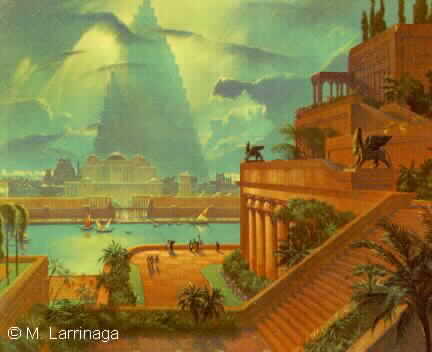


Fruits and flowers... Waterfalls... Gardens hanging from the palace terraces...
Exotic animals... This is the picture of the Hanging Gardens of Babylon in most people's
minds. It may be surprising to know that they might have never existed except in Greek
poets and historians imagination!
Location
On the east bank of the River Euphrates, about 50 km south of Baghdad, Iraq.
History
The Babylonian kingdom flourished under the rule of the famous King, Hammurabi
(1792-1750 BC). It was not until the reign of Naboplashar (625-605 BC) of the
Neo-Babylonian dynasty that the Mesopotamian civilization reached its ultimate glory. His
son, Nebuchadnezzar II (604-562 BC) is credited for building the legendary Hanging
Gardens. It is said that the Gardens were built by Nebuchadnezzar to please his wife or
concubine who had been "brought up in Media and had a passion for mountain
surroundings".
Exotic animals... This is the picture of the Hanging Gardens of Babylon in most people's
minds. It may be surprising to know that they might have never existed except in Greek
poets and historians imagination!
Location
On the east bank of the River Euphrates, about 50 km south of Baghdad, Iraq.
History
The Babylonian kingdom flourished under the rule of the famous King, Hammurabi
(1792-1750 BC). It was not until the reign of Naboplashar (625-605 BC) of the
Neo-Babylonian dynasty that the Mesopotamian civilization reached its ultimate glory. His
son, Nebuchadnezzar II (604-562 BC) is credited for building the legendary Hanging
Gardens. It is said that the Gardens were built by Nebuchadnezzar to please his wife or
concubine who had been "brought up in Media and had a passion for mountain
surroundings".
Northern lights, or Aurora borealis
brings together two mythological deities - Aurora, the Roman goddess of the dawn, and
Boreas, Greek god of the north wind - to describe an event witnessed mostly at night in the
high northerly latitudes. An identical phenomenon, the aurora australis, occurs in the high
latitudes of the Southern Hemisphere, a region that has always been much more sparsely
inhabited than the planet's northern reaches. Only a few eyewitness accounts of the aurora
australis were available before 20th-century explorers arrived in Antarctica.
By contrast, the flowing ribbons, sky-filling swirls, otherworldly glow, gossamer veils, and
brilliant rays of the aurora borealis are a regular presence that has awed and terrified
northern peoples for thousands of years. To Finns the aurora was "fox fire" sparked by
glistening fur. Some Alaskan Inuit saw the dancing souls of deer, seals, salmon, and beluga;
others believed that if they whistled the lights might snatch them away. The Athabascan
saw messages from their dead, the "sky dwellers."
brings together two mythological deities - Aurora, the Roman goddess of the dawn, and
Boreas, Greek god of the north wind - to describe an event witnessed mostly at night in the
high northerly latitudes. An identical phenomenon, the aurora australis, occurs in the high
latitudes of the Southern Hemisphere, a region that has always been much more sparsely
inhabited than the planet's northern reaches. Only a few eyewitness accounts of the aurora
australis were available before 20th-century explorers arrived in Antarctica.
By contrast, the flowing ribbons, sky-filling swirls, otherworldly glow, gossamer veils, and
brilliant rays of the aurora borealis are a regular presence that has awed and terrified
northern peoples for thousands of years. To Finns the aurora was "fox fire" sparked by
glistening fur. Some Alaskan Inuit saw the dancing souls of deer, seals, salmon, and beluga;
others believed that if they whistled the lights might snatch them away. The Athabascan
saw messages from their dead, the "sky dwellers."
HISTORY
The Great Wall started as earth works thrown up for protection by different States. The
individual sections weren't connected until the Qin dynasty (221-206 B.C.). Qin Shihuangdi,
First Emperor of Qin began conscripting peasants, enemies, and anyone else who wasn't
tied to the land to go to work on the wall. He garrisoned armies at the Wall to stand guard
over the workers as well as to defend the northern boundaries. The tradition lasted for
centuries. Each dynasty added to the height, breadth, length, and elaborated the design
mostly through forced labor.
It was during the Ming dynasty (1368-1644) that the Wall took on its present form. The
brick and granite work was enlarged and sophisticated designs were added. The watch
towers were redesigned and modern canon were mounted in strategic areas. The
Portuguese had found a ready market for guns and canon in China, one of the few items of
trade that China didn't already have in abundance. The Ming Emperors, having overthrown
the Hun dominance and expelled their Mongol rulers of the North devoted large portions of
available material and manpower to making sure that they didn't return
Throughout the centuries, armies were garrisoned along the length of the Wall to provide
early warning of invasion and a first line of defense. Great piles of straw and dung used to
build signal fires have been found during excavations. There must have been small garrison
towns spotted along the length. There weren't many farms or trade towns to provide ease,
relaxation and food. The supply trails were over mountains along narrow paths. To bring
supplies to the top, ropes were slung over posts set in the Chinese side of the wall and
baskets were hauled up hand over hand. Supplies must have always been short and chancy,
particularly in the winter.
The Wall served well. Only when a dynasty had weakened from within were invaders from
the north able to advance and conquer. Both the Mongols (Yuan Dynasty, 1271-1368) and
the Manchurians (Qing Dynasty,1644-1911) were able take power, not because of
weakness in the Wall but because of weakness in the government and the poverty of the
people. They took advantage of rebellion from within and stepped into the void of power
without extended wars.
The Great Wall started as earth works thrown up for protection by different States. The
individual sections weren't connected until the Qin dynasty (221-206 B.C.). Qin Shihuangdi,
First Emperor of Qin began conscripting peasants, enemies, and anyone else who wasn't
tied to the land to go to work on the wall. He garrisoned armies at the Wall to stand guard
over the workers as well as to defend the northern boundaries. The tradition lasted for
centuries. Each dynasty added to the height, breadth, length, and elaborated the design
mostly through forced labor.
It was during the Ming dynasty (1368-1644) that the Wall took on its present form. The
brick and granite work was enlarged and sophisticated designs were added. The watch
towers were redesigned and modern canon were mounted in strategic areas. The
Portuguese had found a ready market for guns and canon in China, one of the few items of
trade that China didn't already have in abundance. The Ming Emperors, having overthrown
the Hun dominance and expelled their Mongol rulers of the North devoted large portions of
available material and manpower to making sure that they didn't return
Throughout the centuries, armies were garrisoned along the length of the Wall to provide
early warning of invasion and a first line of defense. Great piles of straw and dung used to
build signal fires have been found during excavations. There must have been small garrison
towns spotted along the length. There weren't many farms or trade towns to provide ease,
relaxation and food. The supply trails were over mountains along narrow paths. To bring
supplies to the top, ropes were slung over posts set in the Chinese side of the wall and
baskets were hauled up hand over hand. Supplies must have always been short and chancy,
particularly in the winter.
The Wall served well. Only when a dynasty had weakened from within were invaders from
the north able to advance and conquer. Both the Mongols (Yuan Dynasty, 1271-1368) and
the Manchurians (Qing Dynasty,1644-1911) were able take power, not because of
weakness in the Wall but because of weakness in the government and the poverty of the
people. They took advantage of rebellion from within and stepped into the void of power
without extended wars.
